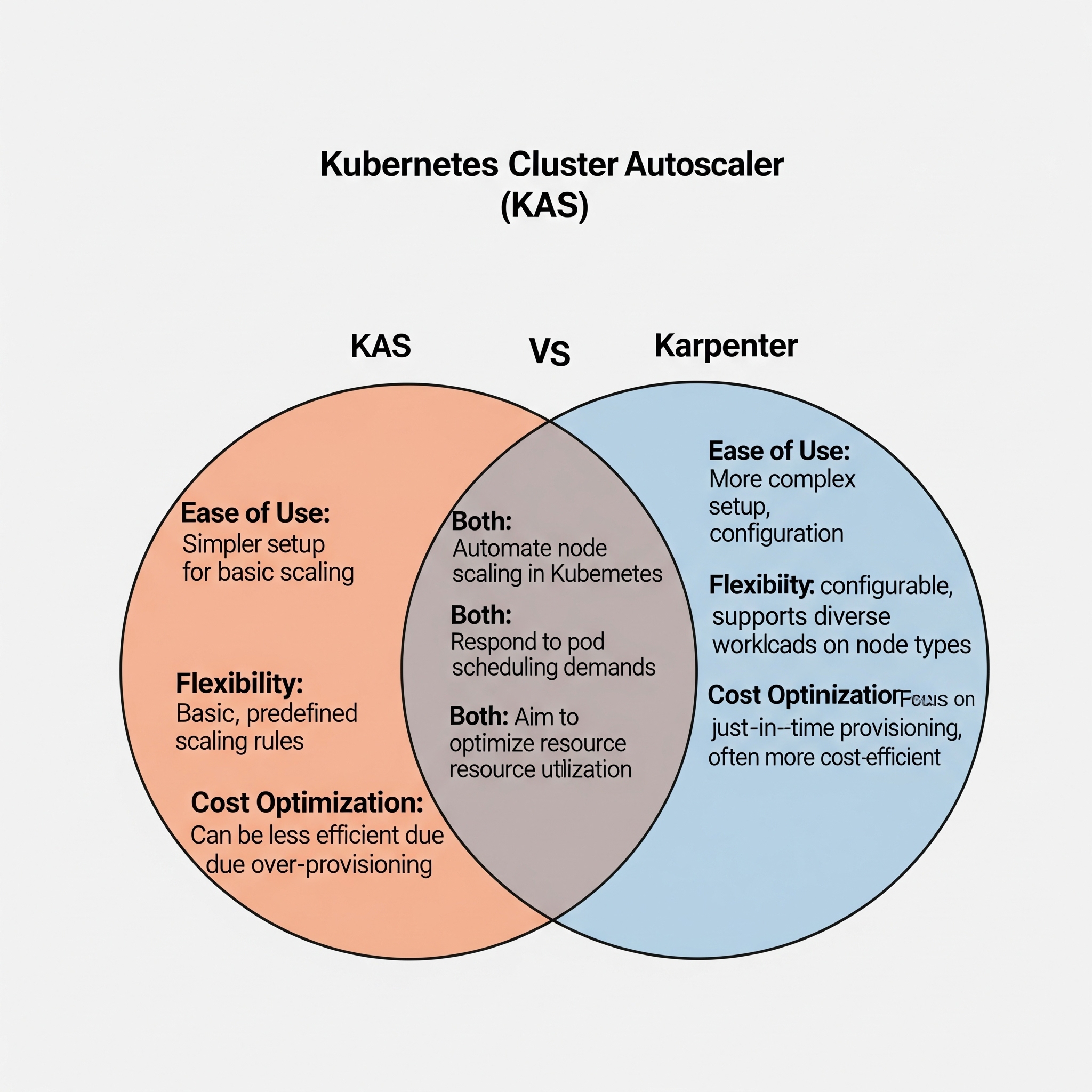
Efficiently scaling your Kubernetes cluster on AWS is crucial for cost management and ensuring sufficient resources for your applications. This decision can be complex, however. This document compares two popular autoscalers—the Kubernetes Cluster Autoscaler (KAS) and Karpenter—to help you choose the best solution for your needs. We will also discuss the advantages of moving beyond traditional node group-based autoscaling. ## Kubernetes Cluster Autoscaler (KAS): The Established Solution KAS is the original Kubernetes autoscaler, a well-established and widely used solution. It adds or removes nodes based on unschedulable pods due to resource constraints. - [DigitalOcean Kubernetes Cluster Autoscaler](https://www.digitalocean.com/products/kubernetes?utm_campaign=search_nb_compute_kubernetes_generic_sa_en&utm_adgroup=cluster&utm_keyword=cluster%20autoscaler&utm_matchtype=p&utm_adposition=&utm_creative=729688111340&utm_placement=&utm_device=c&utm_location=&utm_location=9050527&utm_term=cluster%20autoscaler&utm_source=google&utm_medium=cpc&gad_source=1&gad_campaignid=22144413016&gbraid=0AAAAADw9jcuoEbU6a9EXBtD4MdqUiS9VK&gclid=Cj0KCQjws4fEBhD-ARIsACC3d28qJg1WEVFnHVrpvw0CAAHHA-2-fNcarLfSqlI-so1XoZXArRKJN5UaAl28EALw_wcB) – Learn more about how DigitalOcean implements Kubernetes Cluster Autoscaler. Traditionally, KAS scaled predefined node groups (like EC2 Auto Scaling Groups on AWS). It increases group size when pods lack resources and decreases size when nodes are underutilized. KAS supports managed node groups (EKS), self-managed groups, and ASGs across various cloud providers (AWS, GCP, Azure). Its status as part of the official Kubernetes SIG Autoscaling project provides strong backing. However, KAS's reliance on static configurations can limit scalability. Predefining instance types, minimum/maximum nodes per group, and node labels/taints becomes complex when managing diverse workloads with varying needs (GPUs, CPUs, spot/on-demand instances). ## Karpenter: The Dynamic Approach Karpenter, AWS's next-generation autoscaler, offers dynamic provisioning. Instead of predefined node groups, it uses a workload-first approach, provisioning EC2 instances on demand based on unschedulable pod resource requirements. Manual configuration of ASGs or instance types is eliminated. - [Karpenter](https://karpenter.sh/) – Official documentation and getting started guides. Key benefits include: * **Elimination of Node Groups:** Simplifies management by removing the complexity of ASGs. * **Intelligent Instance Selection:** Automatically chooses optimal instance types (spot or on-demand) for cost optimization. * **Rapid Response Times:** Enables faster scaling compared to KAS. * **Deep AWS Integration:** Leverages EC2 API, pricing models, and availability zones. <img src={require('./img/kas-karpenter-comparison.jpg').default} alt="A Venn diagram comparing and contrasting the features of Kubernetes Cluster Autoscaler (KAS) and Karpenter, highlighting their strengths and weaknesses in terms of ease of use, flexibility, and cost optimization." width="600" height="500"/> <br/> Karpenter uses a custom resource called a `Provisioner` to define policies (preferred zones, capacity types, limits). For example, deploying only on `t3a` spot instances in a specific zone with a 4-hour TTL is easily configured. Refer to the Karpenter documentation for detailed architecture information. ## KAS vs. Karpenter: A Direct Comparison The key differences are summarized below: | Feature | KAS | Karpenter | |-----------------|------------------------------------|--------------------------------------| | Provisioning | Node group-based | On-demand, workload-first | | Instance Selection | Manual configuration | Automatic, optimized | | Configuration | Static, complex for diverse needs | Dynamic, policy-based | | Speed | Slower scaling | Faster scaling | | AWS Integration | Integrates with ASGs | Deep integration with EC2 API | <img src={require('./img/kas-karpenter-workflow.jpg').default} alt="A flowchart illustrating the process of pod scheduling and node provisioning in both KAS (using pre-defined node groups) and Karpenter (dynamic provisioning based on pod requirements)." width="600" height="500"/> <br/> Choosing between KAS and Karpenter depends on your specific needs and infrastructure complexity. For simpler deployments with homogenous workloads, KAS might suffice. However, for dynamic, cost-optimized scaling of diverse workloads, Karpenter offers a more efficient and streamlined solution. ## KAS vs. Karpenter: Kubernetes Autoscaling on AWS For a deeper technical comparison, explore [spacelift.io's article on Karpenter vs. Cluster Autoscaler](https://spacelift.io/blog/karpenter-vs-cluster-autoscaler). This document compares Kubernetes AutoScaler (KAS) and Karpenter, focusing on their approaches to autoscaling within an AWS environment. ## Feature Comparison | Feature | KAS | Karpenter | |-----------------|------------------------------------|--------------------------------------| | Approach | Node group-centric | Workload-centric | | Provisioning | Pre-defined node groups | On-demand, dynamic provisioning | | Instance Types | Predefined | Automatically selected | | Configuration | Complex, static | Simple, flexible | | Speed | Slower | Faster | | AWS Integration | Good | Deep | ## Real-World Scenario: Managing Diverse Workloads - [MDN Web Docs](https://developer.mozilla.org) - Web development reference Consider an EKS cluster running web applications, GPU-intensive machine learning workloads, and batch jobs utilizing spot instances. KAS requires separate Auto Scaling Groups (ASGs) for each—GPUs, spot instances, and on-demand instances—along with meticulously configured node selectors and tolerations in each pod specification. This approach is complex to manage. Karpenter, conversely, seamlessly handles this diversity, automatically provisioning optimal instances for each workload. ## The Verdict The optimal choice depends on deployment complexity and specific needs. KAS suits simpler deployments with well-defined resource requirements. However, for dynamic, complex environments demanding cost optimization and diverse workloads, Karpenter provides a superior, streamlined, and efficient approach to Kubernetes autoscaling on AWS. - [Related article on nife.io](https://nife.io/blog/) - Internal resource ## Karpenter: A Deep Dive Karpenter simplifies Kubernetes autoscaling on AWS. You define a "provisioner" for each workload type—a "recipe" specifying requirements (e.g., `nvidia.com/gpu` for GPU tasks). Karpenter then intelligently selects the appropriate EC2 instance type. <img src={require('./img/karpenter-cost-savings.jpg').default} alt="A graph showing the cost savings achieved by using Karpenter compared to KAS over time, demonstrating the impact of dynamic instance selection and spot instance utilization." width="600" height="500"/> <br/> ## Potential Drawbacks While highly effective, Karpenter has some considerations: * **AWS Identity is Crucial:** Optimal performance relies on IAM roles for service accounts (IRSA) and EC2 instance profile bindings. Secure and well-organized AWS identity configuration is essential. * **Currently AWS-Focused:** Although GCP and Azure support is emerging, Karpenter's strongest performance is currently on AWS. Multi-cloud environments may necessitate alternative solutions. * **Increased Complexity:** Karpenter incorporates more components (webhooks and controllers) than some alternatives, adding complexity, but often justifying itself through enhanced efficiency. ## Karpenter vs. Kubernetes Cluster Autoscaler (KAS): Choosing the Right Tool Is the added complexity of Karpenter worth it? For AWS-native Kubernetes users, the streamlined autoscaling capabilities often outweigh the initial setup effort. ## Choosing Between Karpenter and KAS The decision between Karpenter and the Kubernetes Cluster Autoscaler (KAS) depends on your specific needs. ### Karpenter Ideal for AWS-centric deployments requiring seamless, real-time autoscaling. Its proactive nature simplifies cluster management. ### KAS A robust choice, particularly for multi-cloud or hybrid environments where its broader compatibility is beneficial. It offers a reliable and established solution. ## The Future of Kubernetes Autoscaling? For AWS deployments prioritizing dynamic, cost-effective scaling with minimal overhead, Karpenter warrants serious consideration. It offers a highly responsive approach to infrastructure management. KAS remains a powerful and reliable option, especially in complex, multi-cloud scenarios. The optimal choice depends entirely on your specific context. Need assistance migrating from KAS to Karpenter on EKS? Contact us for guidance. In short, choosing between the Kubernetes Cluster Autoscaler (KAS) and Karpenter hinges on your operational complexity and scaling needs. KAS, the established veteran, offers reliability and broad cloud provider support, but its reliance on pre-defined node groups can lead to configuration overhead, especially for diverse workloads. Karpenter, the dynamic newcomer, shines with its workload-first approach, eliminating the need for manual node group management and automatically selecting optimal instance types for cost efficiency and speed. The choice boils down to whether you prioritize established stability and familiarity or the agility and cost optimization offered by a more modern, dynamic solution. Connect Your Kubernetes Cluster with Ease Using Nife.io, you can effortlessly connect and manage Kubernetes clusters across different cloud providers or even standalone setups: [Connect Standalone Clusters](https://nife.io/solutions/Add%20for%20Standalone%20Clusters) [Connect AWS EKS Clusters](https://nife.io/solutions/Add%20AWS%20EKS%20Clusters) [Connect GCP GKE Clusters](https://nife.io/solutions/Add%20for%20GCP%20GKE%20Clusters) [Connect Azure AKS Clusters](https://nife.io/solutions/Add%20for%20GCP%20GKE%20Clusters) Whether you're using a cloud-managed Kubernetes service or setting up your own cluster, platforms like Nife.io make it easy to integrate and start managing workloads through a unified interface.